Whole-House Cost Range
A standard 2,000 square foot Phoenix home generally falls between $7,000 and $22,000 for full replacement. Mid-range vinyl projects commonly land from $10,000 to $16,000 once labor, disposal, and permit fees are included.
For a 2,000 square foot home in the Phoenix metro area, Phoenix Window Co. uses a broad whole-house planning range of $7,000 to $22,000, while typical Phoenix-area projects average about $4,652 to $8,721. Window count, frame material, glass package, and opening condition determine where a measured project lands.
A standard 2,000 square foot Phoenix home generally falls between $7,000 and $22,000 for full replacement. Mid-range vinyl projects commonly land from $10,000 to $16,000 once labor, disposal, and permit fees are included.
Opening count, frame material, glass package, window size, and structural condition all change the total. A house with 14 standard windows prices differently from one with oversized picture windows or a projecting bay window.
Count and measure every opening, then separate stock, oversized, and shaped units before setting a budget. A calculator based on square footage alone can miss the real total by thousands of dollars in either direction.
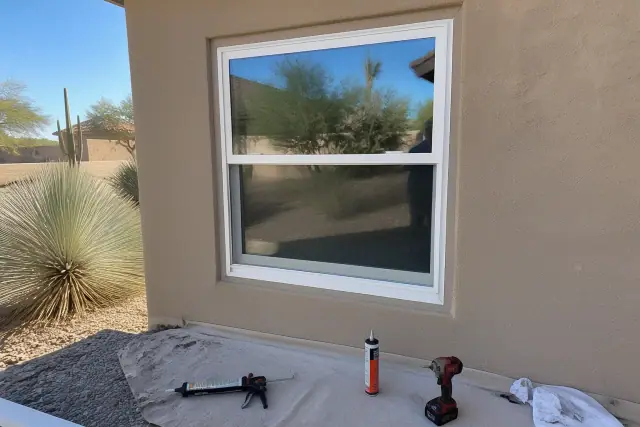
Double-hung windows at $478 to $2,412, casements at $589 to $2,993, sliders at $652 to $2,668, awnings at $750 to $1,886, and bay or bow units at $3,554 to $10,245 installed. The comparison should make standard openings and structurally involved projections easy to distinguish.
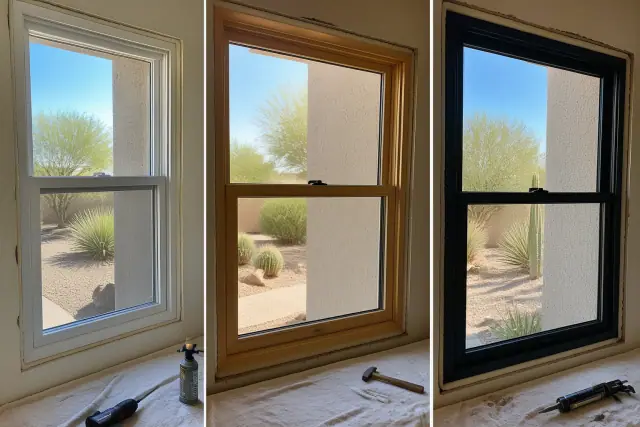
The profile and finish differences among vinyl at $300 to $800, wood at $700 to $1,200, and fiberglass or composite at $800 to $1,500 or more per unit. These material bands explain why equal window counts can produce very different budgets.
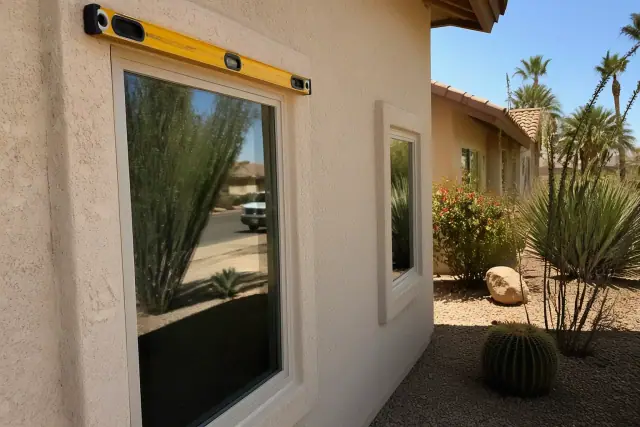
Each opening being counted and measured on a Phoenix ranch-style home. Older ranch homes built in the 1960s and 70s may have about 20 openings and a mix of standard, double-size, and shaped windows.
For 14 to 18 energy-efficient vinyl windows, expect about $9,000 to $18,000 including removal, disposal, standard flashing, and sealing.
At $400 to $1,000 per standard vinyl unit installed, a 20-window project generally runs $12,000 to $20,000. Double-size or shaped openings can move the total past $25,000.
Glass-only work can make sense when the frame is sound and the problem is a crack or failed seal. Full replacement becomes more compelling at 20 years or older, especially for pre-1990s single-pane or early dual-pane windows facing months of average highs above 100°F.
Late fall through winter, roughly November through February, usually brings more scheduling flexibility. January and February promotions can reduce some projects by several hundred dollars compared with peak summer pricing.
| Project or Window Type | Supported Cost Range | What Moves the Total |
|---|---|---|
| Typical Phoenix-area project | $4,652 to $8,721 total | Regional project mix and opening count |
| Full-house replacement | $7,000 to $22,000 total | Usually 12 to 20 openings, plus frame and glass choices |
| 14 to 18 energy-efficient vinyl windows | $9,000 to $18,000 total | Includes removal, disposal, standard flashing, and sealing |
| 14 standard vinyl windows | $8,000 to $14,000 total | Oversized or shaped units can move the project toward $16,000 or more |
| 20 standard vinyl windows | $12,000 to $20,000 total | Double-size or shaped openings can push the project past $25,000 |
| Vinyl frame | $300 to $800 per window before installation | Size and glass package |
| Wood frame | $700 to $1,200 per window | Finish, size, and custom detailing |
| Fiberglass or composite frame | $800 to $1,500 or more per window | Material grade, size, and glass package |
Square footage is a starting point, not the price formula: homes of this size commonly have 12 to 20 openings, and the style mix matters more than floor area alone. Standard vinyl installations blend to about $600 to $900 per window across types, while larger openings, triple-pane glass, or impact-resistant glazing can reach $1,200 or more. A mid-grade, dual-pane Low-E project across 14 to 18 windows is therefore more realistically budgeted at $10,000 to $16,000 than at one flat per-square-foot rate.
Removal and installation labor accounts for roughly 30% to 40% of the project, while Low-E coating and argon fill typically add $50 to $150 per window over basic dual pane. Bay, bow, and custom shapes can add 15% to 20% to a 14-to-18-window budget; shaped units alone range from $705 to $6,276, and projecting windows require extra framing and support. Original steel or aluminum openings in older Sunnyslope and South Mountain homes may need new frame depth, squaring, and flashing, while projects in Encanto-Palmcroft may require custom sightlines and proportions. Single-pane conversions can also require framing adjustments under current Maricopa County building code, and triple-digit summer heat may shift installation to early mornings to protect sealant cure times.
For 14 standard vinyl windows, the supported range is $8,000 to $14,000, with oversized or shaped units moving the total toward $16,000 or more. Replacing all windows in one contract generally saves 10% to 15% versus dividing the work across two or three years because the order uses one material shipment and one crew mobilization. Windows that are 20 years old or more are stronger replacement candidates when seals, hardware, frames, or thermal performance have declined. If failure is not urgent, late fall and winter usually offer shorter lead times and more flexible scheduling than the summer replacement rush.
Share the window count, style mix, and any oversized, fogged, cracked, or damaged openings. An in-home measurement can separate glass-only work from full-frame replacement and produce an itemized scope for labor, removal, disposal, flashing, sealing, and glass-package costs.