.27 Is High Performance
A .27 whole-window rating sits in the excellent 0.20-0.29 tier, outperforming the 0.30-0.35 range common to standard Low-E double-pane windows.
Phoenix Window Co. considers a .27 U-factor a strong target for replacement windows in Phoenix and the Salt River Valley, where summer heat gain can drive cooling demand. It falls within the 0.20-0.29 high-performance range, but the complete choice should also account for SHGC, frame material, window style, and installation quality.
A .27 whole-window rating sits in the excellent 0.20-0.29 tier, outperforming the 0.30-0.35 range common to standard Low-E double-pane windows.
An SHGC of 0.25 or less helps control direct solar gain through west- and south-facing glass, an important companion to .27 during Phoenix's May-through-September cooling season and frequent 100°F-plus days.
Read the NFRC label for the complete unit rather than judging the glass alone; frame conductivity, spacers, gas fill, coatings, seals, and window shape all affect the final rating.
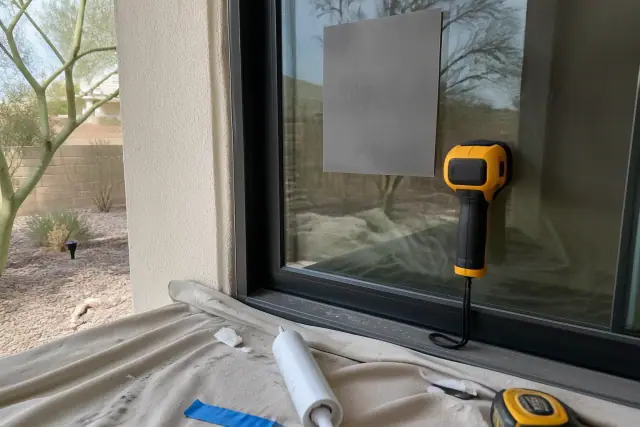
On an NFRC label, .27 appears in the upper-left U-factor field and describes the complete window assembly rather than the glass alone.
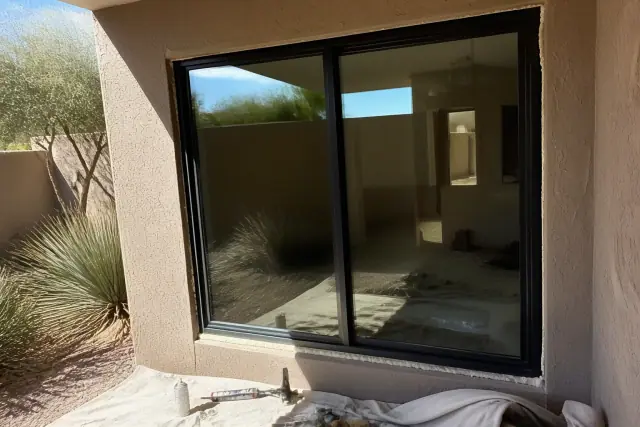
West-facing glass near Arcadia or South Mountain receives intense afternoon sun. That exposure explains why SHGC can matter as much as U-factor in a hot-desert climate.
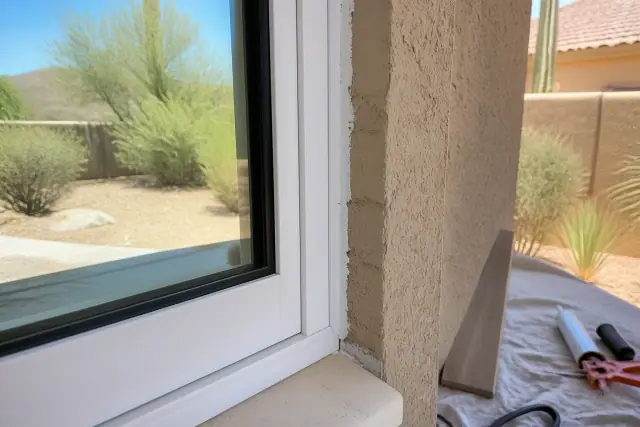
The frame, spacer, flashing, caulk, weatherstripping, and continuous seal all affect performance. These details reveal why a laboratory rating and real-world air leakage are related but not identical.
The 0.20-0.29 range is excellent, and .27 lands here without requiring premium triple-pane construction.
Clear-glass double-pane units typically rate 0.45-0.55, while Low-E double-pane units commonly fall at 0.30-0.35.
Older single-pane aluminum windows commonly rate 0.80-1.20, allowing far more heat transfer than a .27 assembly.
The 0.15-0.25 premium range insulates better, but the added glazing and gas fill often have less value in a cooling-dominated climate than in a cold region.
| Rating or Condition | Source-Backed Benchmark | Practical Meaning |
|---|---|---|
| .27 U-factor | Inside the 0.20-0.29 high-performance range | Strong whole-window insulation against heat transfer |
| 0.30 maximum U-factor | ENERGY STAR Southern climate-zone threshold | .27 clears the threshold with room to spare |
| 0.25 or lower SHGC | Important pairing for hot-dry IECC Zone 2B | Helps limit solar heat through exposed glass |
| Existing rating above 0.40 | Inefficient by current-code benchmarks | Consider an energy audit before choosing the scope |
U-factor measures whole-window heat transfer in Btu per hour per square foot per degree Fahrenheit of temperature difference, and lower is better. The residential scale runs from about 1.20 for a poor single-pane aluminum unit toward roughly 0.20 for leading triple-pane, gas-filled assemblies. A .27 window loses heat about 20 percent slower than a .35 window and roughly half as fast as an older single-pane unit near .80, which helps explain its value during Phoenix's long cooling season.
Maricopa County's IECC Zone 2B makes an SHGC of 0.25 or less especially important beside a .27 U-factor. Vinyl and composite frames generally insulate better than aluminum, while bay and bow windows can rate slightly higher because they contain more frame and seam area. Casement and awning windows often edge out sliding windows by a few hundredths because their continuous seals compress more tightly. Full replacement controls the frame, spacer, gas fill, coating, and glass together; insulated-glass replacement inside an existing frame cannot overcome that frame's conductivity. Permitted new construction and major renovations are reviewed against current local energy requirements, and older block homes near downtown Phoenix or Encanto may still have single-pane aluminum windows rated 0.80-1.10. Because caulking, flashing, shimming, fastening, and weatherstripping affect air leakage, an assessment can be more informative than the sticker on a 15-year-old window.
Is .26 meaningfully better than .27? Both sit in the same high-performance tier, and the one-hundredth difference is usually less important than frame material and SHGC. Is 0.30 still good? It meets the ENERGY STAR Southern-zone maximum, although .27 provides more margin. Can double-pane windows reach .27? Yes—Low-E coatings, argon gas fill, and a well-insulated vinyl or composite frame can produce double-pane ratings from .27 to .30 without moving to triple-pane construction.
A useful window assessment compares the whole-unit U-factor, SHGC, frame material, glass package, seal condition, orientation, and installation scope. Bring the NFRC label or the available window details so a .27 target can be evaluated against the actual opening and project goals.